
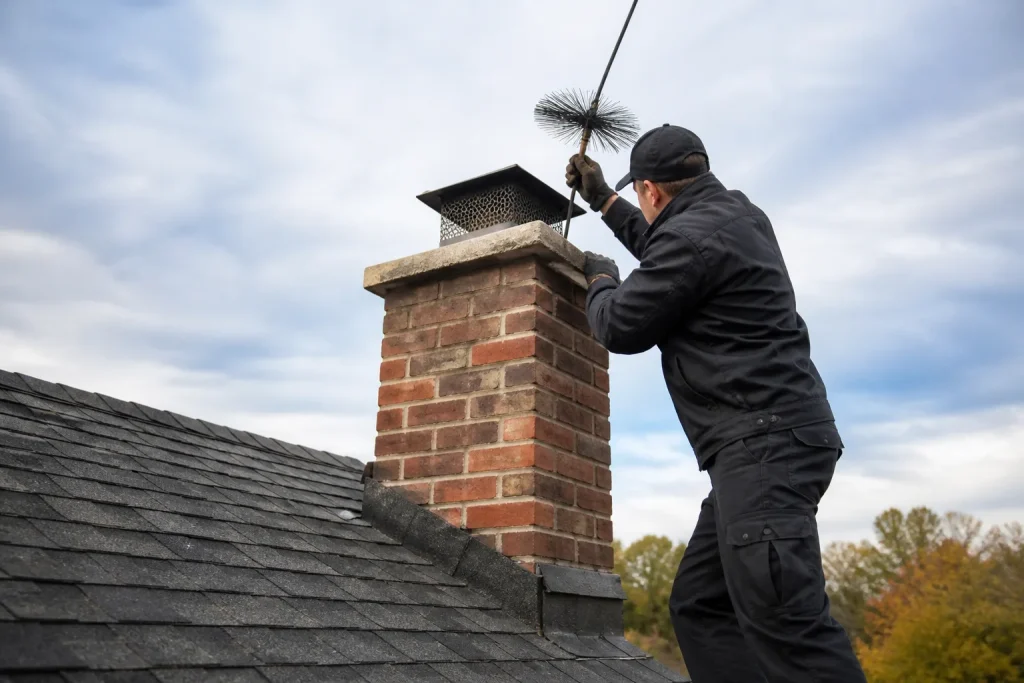
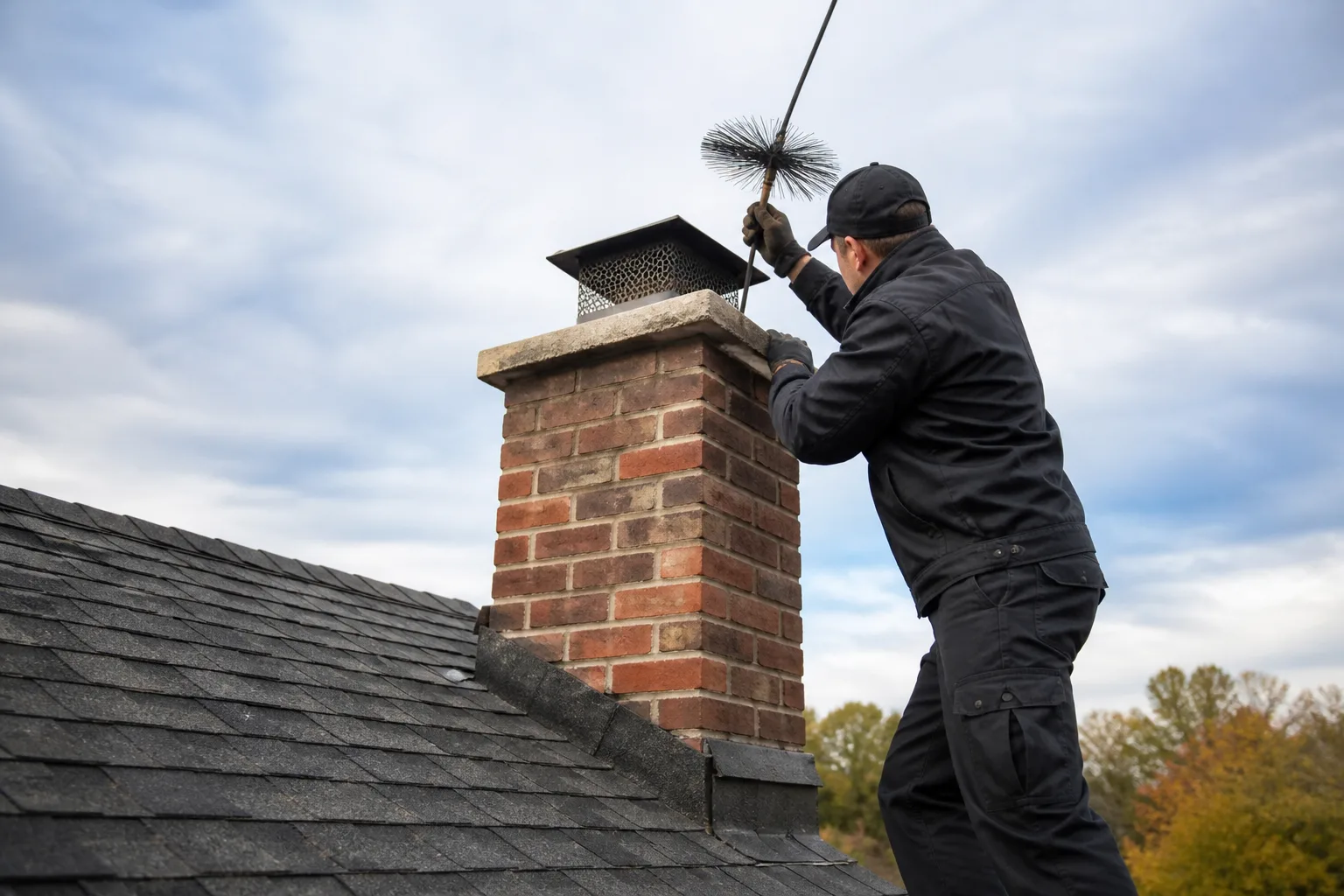
Famco Chimney Sweep in South Bend: A Homeowner’s Guide
A Famco chimney cap does one job that a hardware-store cap doesn’t: it’s engineered to spec for the flue it sits on, and that’s where most South Bend installations go sideways. The $18 galvanized cap from the home center fits the tile, sure. It also rusts thin within two winters and clatters loose in a Lake Michigan wind. Famco products are made to a different standard, and the gap usually shows up in your attic or on your ceiling, not at the fireplace where you’d expect to look.
If you’d rather not climb a ladder and guess, or you’ve been fighting smoke, draft, or water for more than one heating season, call (888) 334-4231. We answer 24/7. Fast dispatch from 7am to 7pm, Sunday through Friday.
Key Takeaways
- Famco makes caps, multi-flue covers, and draft-inducing products specified by engineers, not swapped in by handymen.
- Most South Bend rain and snowmelt problems start at the crown and cap, not the firebox.
- An undersized, mismatched, or poorly fastened cap fails quietly and takes the flue with it.
- Contractor-grade product lines come with warranty support and correct spec; retail lines don’t.
- Nothing is recommended without camera evidence a homeowner can see.
What does Famco actually manufacture, and why does it matter in South Bend?
Famco manufactures chimney caps, multi-flue covers, and vent products engineered to specific drafting and weather requirements. Engineers spec their products because the line covers the whole job: a cap sized to the actual flue count, a draft-inducer for a flue that won’t pull, and structural covers built for long-term weather exposure. That’s different from a $20 retail cap that fits “most” chimneys and satisfies nobody.
In South Bend, the conditions test that engineering. Open-lot properties on the edges of town catch wind with nothing to slow it down, and that wind drives rain sideways, under a bad cap and into the flue. Cold snaps push temperatures well below freezing, then a thaw sends meltwater down the tile. A cap that’s too short, too loose, or missing the right clearance lets all of it in. We’ve watched the same failure pattern play out across South Bend homes: water streaks on the smoke chamber, rusted top plates, and a homeowner wondering why the damper sticks in January.
Famco caps address this because they’re matched to the flue, not just dropped on top of it. A multi-flue cap, for example, sits over several tiles at once, with the geometry to shed water away from the crown and gasketing that seals at the tile. You can’t get that from a one-size retail cover.
Which Famco cap models address South Bend’s high-wind and negative-pressure conditions?
For South Bend’s wind and negative-pressure problems, the cap has to do two things: anchor solidly to the flue and keep the air moving the right direction. Multi-flue stainless covers handle the first; draft-inducing designs handle the second. The distinction matters because an open-lot home with wind across the chimney can create a pressure pocket that pushes smoke back into the living room even when the flue is clean.
Draft-inducing caps use a shaped housing to redirect wind across the flue opening and create upward pull rather than downflow. Multi-flue covers are built for chimneys with more than one tile and engineered to fit the full footprint, not just the biggest opening. Stainless construction resists the freeze-thaw cycling that chews up galvanized steel in this climate.
What we see going wrong on South Bend chimneys:
- Undersized cap. The cover is smaller than the flue opening, so rain finds its way in around the edges.
- Mismatched style. A single-flue cap on a multi-flue chimney leaves the other tiles wide open.
- No draft consideration. The homeowner never had backdraft solved because the cap was chosen for looks, not airflow.
- Clearance ignored. The cap sits too close to the crown or the flue tile, trapping moisture and rotting both.
Model matching is the whole point. It’s also where a general handyman or a cleaning-only sweep runs out of answers.
How do you tell whether your current cap is undersized, mismatched, or installed wrong?
You can check a chimney cap without tools, from the ground or from a second-story window. Look at four things: fit, material, fastening, and clearance. If any one of them is off, the cap isn’t doing its job, regardless of how new it looks.
- Fit. The cap should cover every flue tile with a little overhang. If any tile peeks out past the edge, it’s undersized.
- Material. Galvanized steel will rust in South Bend winters. Stainless or copper is the long-term answer.
- Fastening. A cap secured with screws into the flue tile can crack the tile. Proper fastening anchors without compromising the masonry.
- Crown clearance. The cap needs room above the crown so air circulates and moisture dries. If it sits flush or lower, water pools underneath.
There’s a fifth sign that reads obvious once you know it: rust streaks on the chimney’s exterior. That’s the cap breaking down, and it usually means the top plate is a year or two from failing completely. When we look at a South Bend cap, the questions are the same every time: is the flue tile solid, is the crown pitched, and is the fastening method safe for a clay tile already past its first few decades.
Why does it matter that your chimney company stocks professional-grade brands?
Stocking professional-grade brands changes three things: lead time, warranty support, and the quality of the product itself. A contractor who carries Famco, Copperfield, or Olympia Chimney has the correct spec product when they show up, and if a part fails, you have a warranty line to fall back on. Retail-grade product lines give you neither.
The difference is real. Retail caps are built to a price point and sold in bins. Contractor-grade lines like Famco and Copperfield are built to a spec, sold through supply channels, and backed by the manufacturer’s warranty support. When you need a DuraFlex liner, a HeatShield application, or a Famco multi-flue cover, those products aren’t on a shelf. They’re ordered correctly, sized correctly, and installed by someone who already works with the line.
Here’s the honest version of why a stocked brand matters. If the sweep drives away to “order something,” you’re waiting days or weeks on a ladder with an open flue. If the correct part is ordered right the first time, the cap gets installed in one visit. No hand-off, no second call, no wondering whether the guy who cleans the chimney understands the model spec.
For South Bend homeowners, that reliability matters in the fall. Chimneys get checked before the first fire, and an open flue in the weeks before cold weather is when the moisture damage happens.
What installation details determine whether a Famco product actually performs as rated?
A Famco cap underperforms if the crown, flue tile, or fastening is wrong underneath it. Three details decide whether the product does what it’s rated for: crown clearance, flue tile condition, and fastening method. Skip any one and you’ve paid for an engineered cap that behaves like a retail one.
Crown clearance. The crown is the masonry cap that sheds water away from the chimney body. A Famco cap needs to sit high enough to let air circulate and low enough to keep rain out. If the crown is cracked or sloping the wrong way, no cap fixes it. That’s a chimney repair conversation, and it usually gets handled before any cap goes on.
Flue tile condition. A cap fastens to or around the flue tile. If the tile is spalled or cracked, the anchor point doesn’t exist. We check tile integrity with a camera before spec’ing any cap, and we show the footage. Nothing gets recommended that a homeowner can’t see.
Fastening method. Screws driven straight into clay tile can crack it. Correct fastening anchors into the surrounding masonry or uses a clamp system that doesn’t compromise the tile.
This is the part most comparisons miss. The cap gets the attention because it’s what you see, but the performance is set by the details underneath. A proper chimney sweep visit is where those details get caught in the first place, because the technician is up there with a camera looking at the whole top of the chimney, not just the flue.
When should you call a pro instead of handling this yourself?
Call a pro when the job involves climbing to the top of the chimney, when the flue tile is cracked, or when anything about the crown or fastening looks wrong. Chimney tops are dangerous work: steep pitches, loose masonry, and the potential for a fall that changes a life. It’s also where you can’t see the damage you’re causing by tightening a screw the wrong way.
We’re not telling you that to sell a service. Most cap checks are straightforward, and a homeowner with a good view and a pair of binoculars can rule out an obvious problem. The line is clear: if the issue is below the top of the visible cap, or if anything requires touching the flue tile or crown to fix, that’s a professional job.
The right order of operations is chimney sweep, then inspection, then repair or cap installation. Same specialist handles all three, which is the difference between fixing the problem once and repeating the visit next year.
The Bottom Line
A Famco cap only delivers on its spec when the flue underneath it is sound, the clearance is right, and the fastening doesn’t compromise the tile. The retail cap might fit. It won’t last through South Bend winters, and the damage it lets in shows up in the attic, the smoke chamber, and the ceiling above the fireplace. The right product on the right flue solves the problem for good.
The company that diagnoses, fixes, and certifies is the company that should be doing the work. We handle all three core services: chimney sweep, inspection with camera and photo report, and chimney repair using professional-grade materials like DuraFlex, HeatShield, Famco, Olympia Chimney, and Copperfield. Our technicians have up to 10 years of experience. Nothing gets recommended without camera evidence you can see, and we’ll tell you plainly when work can safely wait.
Related services in South Bend
If you need a sweep, an inspection, or a cap and liner repair, we handle it in one call. The same specialist does the diagnosis and the repair, so there’s no handoff. We serve homeowners across South Bend and the surrounding area.
If you’re in South Bend and need help, Chimney Sweep South Bend offers free estimates. Call (888) 334-4231. We answer 24/7. Fast dispatch from 7am to 7pm, Sunday through Friday.
Frequently Asked Questions
A Famco chimney cap is a contractor-grade product engineered to the flue’s actual dimensions and drafting needs. Retail caps are built to a price point and sold in bins, so they fit “most” chimneys but match none precisely. The difference shows in the material (stainless instead of galvanized), the fitting (multi-flue geometry instead of single-size), and the warranty support behind the product.
You need a cap that fits correctly and holds up to South Bend conditions. That’s true whether it’s Famco, Copperfield, or Olympia Chimney. The point isn’t the brand name; it’s that the cap is sized to your flue, built for freeze-thaw cycling and wind, and installed with proper clearance and fastening. A cap from a professional supply line gets you there. A hardware-store cap usually doesn’t.
It’s often both. Wind across an open flue can create a pressure pocket that pushes smoke back down, and a draft-inducing cap addresses that. But the underlying flue condition matters too: a partially blocked or damaged flue won’t draft well no matter what’s on top. We check the flue with a camera before spec’ing a cap, so the fix addresses the cause. Call (888) 334-4231 for an exact quote. Estimates are free.
Once a year, during the same visit as your annual sweep, is enough for most homes. Caps fail slowly, and the annual check catches the rust, the loose fastening, or the cracked tile before it becomes a ceiling leak. If your chimney sits on an open, windy lot, check the cap visually a few times over winter too. Call (888) 334-4231 to book a visit. We answer 24/7. Fast dispatch from 7am to 7pm, Sunday through Friday.
Written by the team at Chimney Sweep South Bend.
Need Chimney Cleaning Help?
Call Chimney Sweep South Bend - licensed & insured, here with fast help in South Bend.
(888) 334-4231